
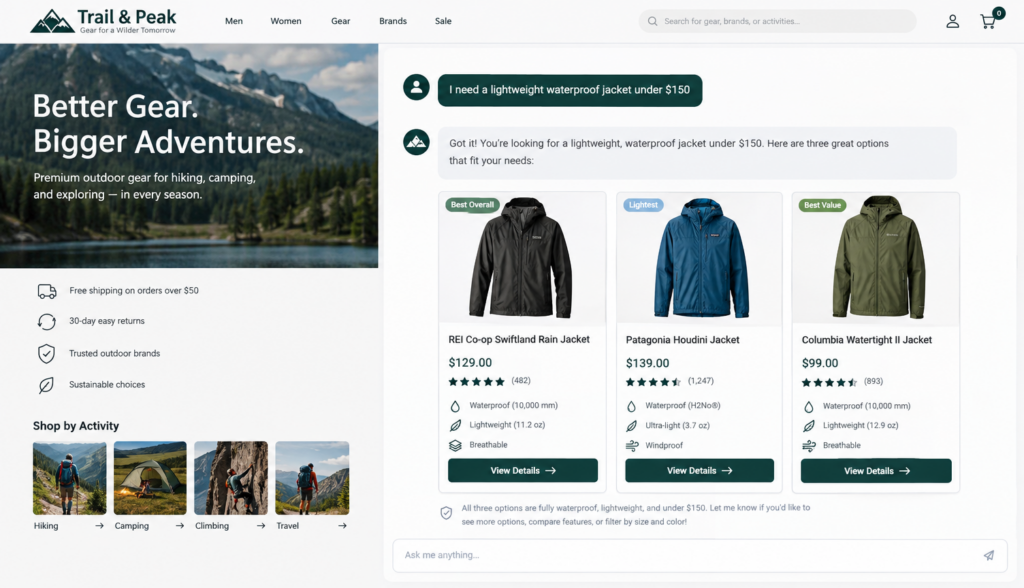
A shopper arrives on your ecommerce site with a specific need: “I need a waterproof hiking jacket for spring trips, lightweight enough to pack, under $150, and available in women’s medium.” Traditional site search often struggles with that kind of request. It may match one or two keywords, ignore the rest, and send the customer into a long list of products that still need to be filtered manually. AI ecommerce search is designed to handle these detailed, natural-language requests more like a knowledgeable store associate would: by understanding what the customer means and helping them find the right product faster.
For ecommerce businesses, this matters because product discovery is directly connected to buying intent. When customers can quickly describe what they want and see relevant options, they are more likely to continue shopping, compare products, and make a confident purchase. When search results are confusing, incomplete, or irrelevant, shoppers often leave.
## The Common Ecommerce Search Problems That Frustrate Shoppers
Most ecommerce websites have some form of search bar, category navigation, and product filters. These tools are useful, but they often place the burden on customers to know exactly how your catalog is organized.
A shopper may understand their need, but not your category structure. For example:
– They search “comfortable shoes for standing all day” instead of “work sneakers.”
– They search “gift for a 10-year-old who likes science” instead of selecting a toy category.
– They search “small dining table for apartment” instead of filtering by dimensions.
– They search “laptop for video editing and travel” instead of choosing processor, RAM, screen size, and weight.
Traditional keyword-based search may only look for exact words in product titles or descriptions. If the product page does not include the same wording the customer used, the right item may not appear. Even when results appear, the customer may still need to sort through pages of products and multiple filters.
Common issues include:
– **Zero-result searches:** The site returns nothing because the customer used different words than the product data.
– **Too many irrelevant results:** Search matches a broad keyword but misses the shopper’s real intent.
– **Filter fatigue:** Customers must manually narrow down size, color, price, features, rating, inventory status, and shipping options.
– **Poor handling of long queries:** Detailed searches are treated as separate keywords instead of one complete request.
– **Weak product comparisons:** Customers can find products, but not easily understand which one best fits their use case.
These issues are not just technical inconveniences. They create uncertainty. And when shoppers are uncertain, they may delay the purchase, contact support, or leave for another site that feels easier to use.
## How AI Ecommerce Search Improves Product Discovery
AI ecommerce search uses artificial intelligence to understand a shopper’s words, intent, and context instead of relying only on exact keyword matches. It can interpret longer, more conversational requests and connect them to products, categories, FAQs, buying guides, and other approved website content.
In simple terms, traditional search asks, “Which products contain these words?” AI-powered search asks, “What is this customer trying to find, and which products best match that need?”
That shift is important for ecommerce. Many customers do not search using perfect product names. They search using problems, preferences, occasions, and constraints.
For example:
– “Best office chair for lower back pain”
– “Non-toxic baby shampoo for sensitive skin”
– “Black dress for a winter wedding”
– “Beginner-friendly espresso machine under $500”
– “Dog food for a senior lab with allergies”
These searches include intent, requirements, and context. AI site search can help interpret all of that information and surface more appropriate products.
It can also help customers move from vague needs to specific choices. A shopper may start with “I need a durable backpack for work and weekend trips.” AI search can identify key requirements such as durability, laptop storage, capacity, comfort, and travel use, then guide the shopper toward relevant products or ask a clarifying question if needed.
## Natural-Language Product Searches Make Shopping Easier
Natural-language search allows customers to type questions or requests the way they would speak to a sales associate. Instead of forcing shoppers to use short keywords or predefined filters, it lets them explain what they need in their own words.
A standard search bar may handle “running shoes” but struggle with:
“Running shoes for flat feet, mostly road running, around 20 miles per week, men’s size 11.”
An AI-powered site search can break that query into meaningful requirements:
– Product type: running shoes
– Foot support need: flat feet or stability support
– Use case: road running
– Activity level: regular weekly mileage
– Size: men’s 11
With the right product information available, the system can return shoes that better match the shopper’s intent. It may also highlight why certain products are relevant, such as support features, cushioning, or road-running design.
This creates a more helpful experience because customers do not need to translate their needs into your site’s internal terminology. They can search naturally, and the website can respond in a way that feels more useful.
Natural-language search is especially valuable for products with:
– Multiple technical specifications
– Fit, size, or compatibility requirements
– Use-case differences
– Lifestyle or preference-based buying decisions
– Large catalogs with many similar items
– Accessories and add-ons that depend on the main product
The more complex the buying decision, the more helpful intelligent search can become.
## Understanding Customer Requirements Beyond Keywords
A strong ecommerce search experience is not only about matching products. It is about understanding requirements.
Consider a customer searching:
“I need a compact stroller that fits in a small car trunk and works for travel.”
A traditional search may return any product containing “compact,” “stroller,” or “travel.” AI search can interpret the request more deeply:
– The customer needs a stroller.
– Size and portability are important.
– Trunk fit suggests folded dimensions matter.
– Travel use may imply lightweight design, easy folding, and carry features.
If the product catalog includes details such as dimensions, weight, folding style, and travel compatibility, AI search can use that information to present better matches.
This is where semantic search becomes useful. Semantic search focuses on meaning rather than exact wording. It helps connect related concepts even when the same words are not used. For example, a product described as “lightweight and foldable” may still be relevant to a search for “easy to travel with,” even if the exact phrase does not appear on the product page.
AI can also help interpret common buying signals such as:
– Budget: “under $100,” “mid-range,” “premium”
– Compatibility: “works with iPhone,” “fits 2018 Toyota Camry”
– Audience: “for beginners,” “for toddlers,” “for professional use”
– Conditions: “for sensitive skin,” “for cold weather,” “for small spaces”
– Preferences: “eco-friendly,” “easy to clean,” “low maintenance”
– Urgency: “available today,” “fast shipping,” “in stock”
When these requirements are understood, search results become more relevant and useful.
## Using Approved Product and Website Information
For ecommerce AI search to be trustworthy, it should answer from approved business information. That may include product descriptions, specifications, inventory details, FAQs, return policies, sizing guides, warranty information, and buying guides.
One common approach is called retrieval-augmented generation, often shortened to RAG. The concept sounds technical, but the business idea is simple: instead of having an AI tool make up an answer from general internet knowledge, the system retrieves relevant information from your approved content and uses that information to respond.
For an ecommerce site, this can help the AI assistant answer questions such as:
– “Will this replacement filter fit model X?”
– “Which of these jackets is warmest?”
– “Do these shoes run wide?”
– “What is the difference between these two laptops?”
– “Can I return an opened item?”
– “Which skincare product should I use first?”
The quality of the response depends on the quality and completeness of the information available. If product pages are thin or important specs are missing, AI search has less to work with. But when product data is detailed and well organized, intelligent search can help customers use that information more effectively.
Chatbotbiz.ai is designed for this type of business website use case. It works with a company’s website content, product information, FAQs, documents, and other approved sources so customers can ask questions naturally and receive relevant guidance based on the business’s own information.
## Product Discovery Without Forcing Customers Through Filters
Filters are still useful. Many shoppers want to narrow results by size, color, price, brand, rating, or availability. But filters work best when customers already know how to evaluate the product category.
AI ecommerce search can make the discovery process easier by doing some of that narrowing automatically based on the customer’s request.
For example, instead of making a customer select:
– Category: Outdoor gear
– Subcategory: Jackets
– Gender: Women
– Size: Medium
– Feature: Waterproof
– Weight: Lightweight
– Price: Under $150
– Use: Hiking
The customer can simply type:
“Women’s medium waterproof hiking jacket, lightweight, under $150.”
The search experience can then return relevant products and, when appropriate, offer additional refinements such as color, brand, insulation level, or availability.
This is especially helpful on mobile devices, where filter menus can be harder to navigate. A conversational search experience can reduce the number of taps required and help customers reach relevant products more quickly.
It can also help when customers are not sure which filters matter. A shopper looking for a “good camera for travel photography” may not know whether to filter by sensor size, lens type, weight, stabilization, or battery life. AI search can guide the shopper based on the intended use instead of asking them to master the product category first.
## Smarter Recommendations Based on Shopper Intent
Product recommendations are common in ecommerce, but they are often based on broad rules such as “popular products,” “related items,” or “customers also viewed.” Those recommendations can be useful, but they may not reflect the individual shopper’s current intent.
AI-powered recommendations can use the customer’s search request and follow-up questions to suggest products that better fit their needs.
For example, if a customer asks:
“I need a quiet blender for smoothies in a small apartment.”
A helpful recommendation should prioritize more than just blenders. It should consider:
– Noise level
– Countertop size
– Smoothie performance
– Ease of cleaning
– Price range if mentioned
– Customer reviews or product descriptions that reference quiet operation, if available
The AI assistant might also recommend accessories or related products when they are genuinely useful, such as travel cups or replacement blades. The key is relevance. Recommendations should support the customer’s decision, not distract from it.
Intent-based recommendations can help with:
– Upsells: Suggesting a higher-capacity or more durable version when it fits the customer’s use case.
– Cross-sells: Recommending compatible accessories, refills, cables, cases, or maintenance items.
– Bundles: Helping customers find complete solutions instead of single products.
– Alternatives: Suggesting similar products when an item is out of stock or does not meet a requirement.
– Comparisons: Helping customers choose between two or three close options.
When recommendations are tied to what the shopper actually asked for, they feel more like assistance and less like advertising.
## Connecting Better Search to Conversion Opportunities
Improved product discovery can support conversions because it reduces friction between interest and purchase. When customers find relevant products faster, they can spend more time evaluating value and less time fighting the website.
AI ecommerce search can create conversion opportunities in several practical ways.
### It Helps High-Intent Shoppers Act Quickly
A customer who searches with specific requirements is often closer to a purchase than someone who is casually browsing. If your site can interpret that detailed request and show relevant products, you are meeting the shopper at a high-intent moment.
For example:
“Organic cotton crib sheets, neutral colors, in stock.”
This shopper has already defined the product type, material, style, and availability requirement. A strong AI search experience can move them directly toward suitable options.
### It Reduces Abandonment From Poor Results
If a site returns irrelevant products, the customer may assume the store does not carry what they need. AI search can reduce missed matches caused by wording differences, incomplete queries, or unfamiliar category names.
For example, a customer searching “sofa for small living room” may still be interested in products labeled as “loveseat,” “apartment sofa,” or “compact sectional.” Semantic understanding helps connect those related terms.
### It Supports More Confident Buying Decisions
Many shoppers do not leave because they cannot find a product. They leave because they are unsure whether it is the right product.
An AI assistant can help answer questions that often block purchases:
– “Will this fit?”
– “Is this compatible?”
– “What size should I choose?”
– “What is the difference between these models?”
– “Is this good for beginners?”
– “Does this come with everything I need?”
When answers come from approved product and website information, customers can make decisions with more confidence.
### It Keeps Customers Engaged on the Website
Instead of sending customers to external search engines, support inboxes, or competitor sites for clarification, intelligent site search can keep the conversation on your website. The customer can ask follow-up questions, compare options, and continue moving toward a purchase without starting over.
A good ecommerce search experience should feel like guided shopping, not just information retrieval.
## Practical Examples of AI Ecommerce Search in Action
To see how this works, consider a few common ecommerce situations.
### Apparel
A shopper searches:
“Black dress for a formal winter wedding, long sleeves, not too short.”
AI search can interpret the occasion, season, color, sleeve preference, and length concern. Instead of returning every black dress, it can prioritize formal styles, long sleeves, midi or maxi lengths, and heavier seasonal fabrics if those details exist in the product data.
### Electronics
A shopper asks:
“Which laptop is best for college students who need video editing but also want something lightweight?”
The search experience can look for products with relevant performance features, portability, battery considerations, and student-friendly use cases. It may also present comparisons between suitable models.
### Beauty and Skincare
A shopper types:
“Moisturizer for oily sensitive skin that won’t feel greasy.”
AI search can connect “won’t feel greasy” with lightweight, oil-free, non-comedogenic, or gel-based moisturizers if those attributes are included in the content.
### Home Goods
A shopper searches:
“Dining table for four people in a small apartment.”
Rather than only matching “dining table,” AI search can prioritize compact dimensions, round or drop-leaf designs, and seating capacity for four.
These examples show why natural-language understanding is valuable. Customers often describe outcomes, concerns, and situations. Ecommerce search needs to connect those descriptions to the products that fit.
## What Ecommerce Businesses Need for Better AI Search
AI search works best when it has strong information to work with. Before implementing intelligent site search, ecommerce teams should review the content and data that supports product discovery.
Helpful inputs include:
– Clear product titles
– Detailed product descriptions
– Accurate specifications
– Size charts and fit notes
– Compatibility information
– Materials and ingredients
– Use cases and buying guides
– FAQs and policy pages
– Inventory and availability data, when connected
– Customer support documentation
It is also important to think about common customer questions. What do shoppers ask before buying? What questions does your support team answer repeatedly? What product comparisons come up often? Those answers can become valuable content for AI-powered search and chat.
The goal is not to replace your product pages, navigation, or filters. It is to make all of that information easier for customers to access through natural conversation and smarter search.
## Conclusion: Better Search Helps Customers Buy With Confidence
AI ecommerce search helps customers find the right product by understanding natural-language requests, interpreting requirements, and connecting shoppers with relevant products and information. Instead of forcing customers to browse through categories and filters alone, it allows them to describe what they need and receive more useful guidance.
For ecommerce businesses, this creates meaningful conversion opportunities. Better product discovery can reduce frustration, support confident decisions, improve recommendations, and keep high-intent shoppers engaged on the website.
The most effective approach is not a general-purpose chatbot disconnected from your store. It is an AI assistant and intelligent site search experience built around your approved product data, website content, FAQs, and business information. When customers can ask better questions and receive relevant answers, your ecommerce site becomes easier to shop—and easier to buy from.