
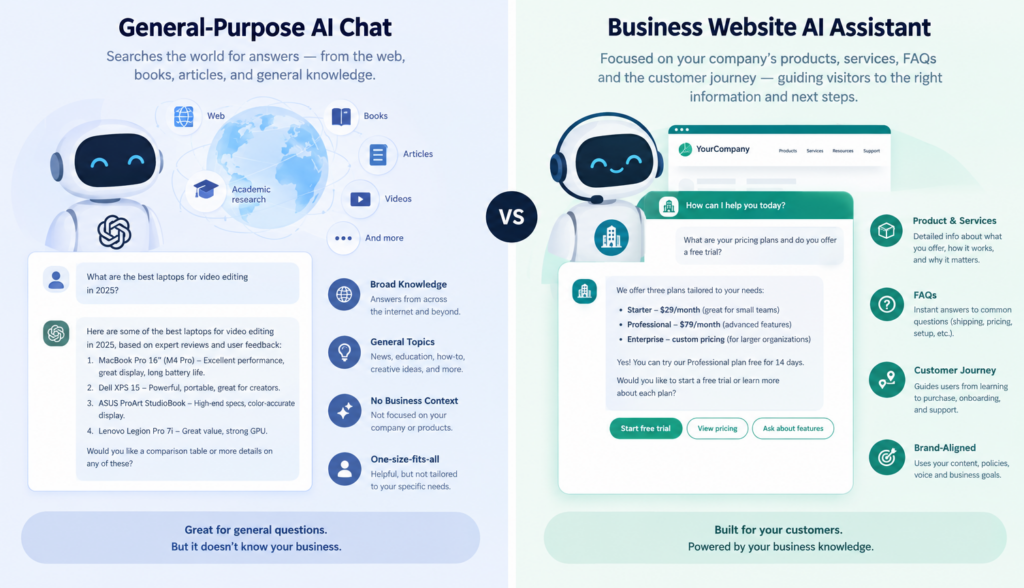
If you are considering AI for your business website, it is easy to assume that “ChatGPT” and “AI chatbot” mean the same thing. They are related, but they are not interchangeable. ChatGPT is a general-purpose AI assistant designed to answer a wide range of questions and help with many types of tasks. An AI chatbot for website use, on the other hand, is designed to help your visitors find answers, understand your products or services, and take action on your site.
That difference matters. A customer visiting your website is not usually looking for a broad conversation about any topic. They want to know whether a product is in stock, which service is right for them, how pricing works, what your return policy says, or how to contact the right department. A website AI assistant is built around those business-specific needs.
Understanding the difference between ChatGPT and a website AI assistant can help you make better decisions about customer experience, website search, support automation, and online conversions.
## What ChatGPT Does
ChatGPT is a general-purpose AI assistant. It can write emails, summarize information, answer common knowledge questions, generate ideas, explain concepts, create outlines, translate text, help with code, and support many other tasks.
For individuals and teams, ChatGPT can be very useful. A marketer might use it to brainstorm blog topics. A business owner might ask it to draft a customer email. A student might use it to understand a complex subject. A developer might use it to troubleshoot code.
Its strength is flexibility. ChatGPT is trained to respond to a huge variety of prompts across countless topics. That makes it valuable as a broad productivity tool.
However, that same flexibility is also a limitation when the goal is to support visitors on a specific business website. Unless it is connected to your approved business information, ChatGPT does not automatically know your current products, policies, pricing, services, inventory, locations, documentation, or support process. It may provide a general answer, but general answers are not always what your customers need.
For example, if someone asks, “What is the best running shoe for flat feet?” ChatGPT can provide general advice. But if that visitor is on your ecommerce site, they probably need to know which shoes you sell, which sizes are available, whether a specific model is in stock, and how to compare options. That requires business-specific knowledge, not just general knowledge.
## What an AI Chatbot for Website Use Does
An AI chatbot for website use is different because it is focused on your business, your content, and your visitors’ goals.
Instead of trying to answer every possible question in the world, a website AI assistant is designed to answer questions based on your approved sources, such as:
– Website pages
– Product catalogs
– Service descriptions
– Help center articles
– FAQs
– Policy pages
– Blog posts
– PDF documents
– Internal knowledge base content, when connected and approved
– Other business-specific information
This allows the assistant to act as a natural-language guide for your website. Visitors can ask questions in their own words instead of digging through menus, filters, and search results.
For example, a visitor might ask:
– “Do you offer installation?”
– “Which plan is best for a small business?”
– “Can I return an item after 30 days?”
– “Do you ship to Canada?”
– “What’s the difference between these two products?”
– “Where can I find your warranty information?”
– “Do you have vegan options?”
– “How do I book a consultation?”
A website AI assistant can use your actual content to provide relevant answers and guide the visitor toward the next step. That next step might be reading a product page, completing a lead form, booking an appointment, starting checkout, requesting a quote, or contacting support.
In other words, ChatGPT is built for broad assistance. A website AI assistant is built for focused customer interaction on your site.
## Business-Specific Knowledge Is the Biggest Difference
The most important distinction is knowledge source.
ChatGPT can answer based on what it has learned from its training and any information provided in the conversation. A website AI assistant should answer from your business’s approved content. This is especially important because customers are often asking questions where accuracy matters.
Consider these examples:
### Example 1: A service business
A visitor asks, “Do you provide emergency appointments on weekends?”
A general AI tool might explain how emergency appointments usually work in that industry. But that does not answer the real question. The visitor needs to know your actual policy.
A website AI assistant can refer to your service pages, scheduling information, and support content to answer based on your business. If weekend emergency appointments are available only in certain locations, it can direct the visitor to the right page or suggest contacting the correct office.
### Example 2: An ecommerce store
A shopper asks, “Which of these jackets is waterproof?”
A general assistant may describe common jacket materials or explain the difference between water-resistant and waterproof. That can be helpful, but it does not identify which products in your catalog meet the shopper’s need.
A website AI assistant can use product descriptions, attributes, and category information to help the shopper narrow their choices.
### Example 3: A B2B software company
A buyer asks, “Does your platform integrate with Salesforce?”
ChatGPT can explain what Salesforce integrations are. A website AI assistant can answer based on your integration page, documentation, and product information. It can also link the visitor to the integration details or suggest booking a demo if the use case is complex.
Business-specific knowledge is what turns AI from a general conversation tool into a practical website experience.
## Website Content Becomes Easier to Use
Most business websites already contain a lot of useful information. The problem is that visitors do not always know where to find it.
Navigation menus, category pages, filters, and search bars are helpful, but they require the visitor to know what to click or what keyword to type. Many people do not search in the same language businesses use on their websites.
For example, your website might have a page titled “Enterprise Implementation Services,” while a visitor asks, “Can you help our team get set up?” Traditional keyword search may not connect those two phrases well. A natural-language AI assistant can understand the intent behind the question and guide the visitor to the right content.
This is where concepts such as semantic search and natural-language search become useful.
Semantic search means the system looks at meaning, not just exact word matches. Natural-language search means people can ask questions the way they would ask a person. Together, they make website content more accessible.
Instead of forcing visitors to search with perfect keywords, an AI assistant can understand questions like:
– “What do I need to get started?”
– “Is this good for beginners?”
– “Can I use this with my existing system?”
– “What happens after I sign up?”
– “How much does shipping cost?”
– “Do you have something for a team of 50?”
This helps visitors move through your website with less friction. It also helps businesses get more value from the content they have already created.
## How RAG Helps Website AI Assistants Stay Focused
One term you may hear when comparing ChatGPT with website AI assistants is RAG, which stands for retrieval-augmented generation.
That sounds technical, but the basic idea is simple.
A standard AI model generates answers based on patterns it has learned. RAG adds a retrieval step. Before answering, the system searches approved information sources, retrieves relevant content, and then uses that content to produce a response.
For a business website, this is important because the assistant should not simply “guess” an answer. It should look for the relevant information in your website content, product data, FAQs, or documents before responding.
In practical terms, RAG helps a website AI assistant:
– Use your current business information
– Stay focused on approved sources
– Provide more relevant answers to customer questions
– Link visitors to useful pages or resources
– Reduce reliance on broad, generic responses
RAG does not mean every answer will be perfect, and businesses still need to review their content and configuration. But it is a useful approach for making AI more grounded in the information that matters to your customers.
## Customer Questions Are Often More Specific Than You Think
Businesses often organize websites around departments, product lines, or marketing priorities. Customers organize their questions around what they are trying to accomplish.
That difference creates friction.
A customer does not necessarily think, “I need to visit the documentation section and read the implementation overview.” They ask, “How long does setup take?”
A shopper may not know which product category applies. They ask, “What should I buy for a small apartment?”
A prospective client may not understand your service tiers. They ask, “Do you work with companies like ours?”
These questions are specific, situational, and often tied to purchase intent. A website AI assistant can help by interpreting the question, finding relevant content, and giving the visitor a useful next step.
Common website visitor questions include:
– Product fit: “Which option is right for me?”
– Pricing: “How much does this cost?”
– Availability: “Do you have this in stock?”
– Policies: “Can I return this?”
– Compatibility: “Will this work with my system?”
– Process: “What happens after I submit the form?”
– Support: “How do I fix this issue?”
– Location: “Do you serve my area?”
– Trust: “Do you have case studies or reviews?”
– Next steps: “How do I get started?”
A general-purpose assistant can help explain concepts around these questions. A website AI assistant can answer them in the context of your business.
## Conversion Goals: Helping Visitors Take the Next Step
A website is not just an information library. It usually has business goals.
Those goals may include:
– Generating leads
– Increasing ecommerce sales
– Booking appointments
– Reducing support tickets
– Helping customers choose the right product
– Encouraging quote requests
– Directing visitors to the right team
– Improving self-service
– Increasing engagement with key content
This is another area where a website AI assistant differs from ChatGPT. ChatGPT is not inherently aware of your website’s conversion paths. It does not automatically know which product page, service page, booking form, or support article a visitor should use.
A website AI assistant can be designed around your customer journey. It can answer questions and then guide visitors toward the most relevant action.
For example:
– If a visitor asks about pricing, the assistant can explain the pricing information available on your site and link to the pricing page.
– If a shopper asks which product is best for a specific need, the assistant can suggest relevant categories or products.
– If a prospect asks whether your service is available in their area, the assistant can direct them to the location page or contact form.
– If a customer asks a support question, the assistant can point them to the right help article or support channel.
The goal is not to push visitors aggressively. The goal is to reduce confusion and make the next step easier.
When visitors can quickly find what they need, they are more likely to stay engaged. For businesses, that can support better customer experience and more efficient website performance.
## Website AI Assistants and Intelligent Site Search Work Together
Traditional site search often depends on keywords. If a visitor types the right phrase, they may find the right page. If they use different wording, misspell something, or ask a full question, results may be less useful.
An AI chatbot for website use can work alongside intelligent site search to improve the experience. Instead of showing only a list of pages, the system can interpret the visitor’s question and provide a direct answer, helpful links, or suggested next steps.
For example, a traditional search for “refund after opened package” might return several policy pages. An AI-powered website assistant can understand that the visitor is asking whether opened items are eligible for refunds and can summarize the relevant policy if that information exists in your approved content.
This is especially helpful for websites with:
– Large product catalogs
– Detailed documentation
– Many service pages
– Complex pricing or plans
– Technical product information
– Multiple locations
– Extensive FAQ or support content
The more content your website has, the more important it becomes to help visitors find the right information quickly.
## When ChatGPT Is the Better Fit
ChatGPT is still very useful. It may be the better tool when you need broad assistance that is not tied to one specific website visitor experience.
For example, ChatGPT can help with:
– Drafting internal documents
– Brainstorming campaign ideas
– Summarizing general topics
– Creating first drafts of content
– Role-playing sales conversations
– Explaining technical concepts
– Writing code snippets
– Generating training materials
These are productivity tasks. They are often performed by your team behind the scenes.
A website AI assistant serves a different purpose. It works directly with visitors and customers on your website, where accuracy, context, and business-specific guidance matter.
## When a Website AI Assistant Is the Better Fit
A website AI assistant is the better fit when your goal is to help website visitors answer questions and take action based on your business information.
It is especially useful when:
– Visitors often ask the same questions before buying or contacting you
– Your website has a lot of content but users struggle to find the right page
– Your products or services require explanation
– Customers need help comparing options
– Your support team handles repetitive questions
– You want to improve self-service without hiding human support
– Your site search is too dependent on exact keywords
– You want visitors to get answers without leaving your website
For many businesses, the question is not whether ChatGPT or a website assistant is “better.” They solve different problems.
ChatGPT helps people work with general information and tasks. A website AI assistant helps your customers work with your business information.
## What to Look for in an AI Chatbot for Website Use
If you are evaluating an AI chatbot for website implementation, focus on how well it supports your visitors and your business goals. The most useful solution is not simply the one that sounds the most advanced. It is the one that can provide accurate, helpful answers based on the content you trust.
Look for capabilities such as:
– The ability to use your website content, FAQs, documents, and product information
– Natural-language question answering
– Intelligent site search or semantic search
– Clear links to relevant pages and resources
– Support for customer questions, not just scripted responses
– Controls over approved knowledge sources
– Easy updates as your content changes
– A user experience that fits naturally into your website
– The ability to guide visitors toward useful next steps
Chatbotbiz.ai, for example, is designed as an AI assistant and intelligent site search solution for business websites. Rather than acting as a general-purpose chatbot, it works with a company’s website content, product information, FAQs, documents, and other approved information to answer customer questions in natural language.
That business-specific focus is what separates a website assistant from a broad AI tool.
## Conclusion: ChatGPT and Website AI Assistants Serve Different Jobs
ChatGPT and a website AI assistant are both powered by AI, but they are built for different purposes. ChatGPT is a flexible general-purpose assistant that can help with a wide range of tasks. An AI chatbot for website use is focused on your business, your content, your customers’ questions, and your website’s conversion goals.
For business owners, ecommerce managers, marketers, and website teams, the key question is not simply, “Should we use AI?” It is, “Where do our visitors need help, and what information should the AI use to help them?”
If your goal is internal productivity, ChatGPT can be a valuable tool. If your goal is to help visitors find answers, compare options, understand your services, and take the next step without leaving your site, a website AI assistant is the better fit.